Quick answer: In ARC Raiders, keep ARC components and workshop materials, sell trinkets and decorative tech for Coins, and recycle only junk that breaks down into materials you actually use. If you die in a raid, you lose everything except what is in your Safe Pocket, so blueprints, quest items, rare crafting parts and Raider Hatch Keys go in the Safe Pocket first. Recycling gives full yield only at the workbench in Speranza, while salvaging inside a raid returns roughly half the materials. Your stash fills up fast, so attach loose mods to weapons, store materials as loot items where you can, and use the sort and compact button before you drop anything.

How loot works in ARC Raiders
Bullet summary
- If you die, you lose everything except what is in your Safe Pocket.
- Your Safe Pocket auto-extracts its contents even if you die.
- Backpack space and weight both limit what you can carry.
- Each raid lasts 30 minutes. When the timer hits zero, an orbital strike wipes the map.
Every loot decision in ARC Raiders starts with one rule. If you go down, you lose everything except what is in your Safe Pocket. The ARC Raiders Wiki states it plainly, and every loot guide repeats it: if you die, you lose everything. That single rule shapes every loot decision.
Your Safe Pocket is the one protected slot that auto-extracts its contents even if you die. You start with one slot when you use a non-free augment. The free loadout has no Safe Pocket at all, which is one more reason to stop running it once you can afford a basic augment. Looting MK.2 adds a second slot, and Epic Looting MK.2 gives you three slots. That is the whole safety net.
Two limits control how much you can carry. Your backpack holds 16 to 24 slots, and your weight limit runs from 40 to 80, depending on your augment. Heavy parts eat weight fast, light trinkets eat slots fast. Watch both numbers.
Each raid lasts 30 minutes. When the timer hits zero, an orbital strike wipes the map. The best loot sits deeper inside, and the deeper you go, the longer the trip back. A full backpack is worth nothing if the strike catches you still looting.
There are three ways to turn loot into progress. Selling Topside loot is the main way to earn Coins. Recycling breaks items into crafting materials, and it only gives full yield in Speranza, at your hideout workbench. Salvaging inside a raid returns less, roughly half the materials. Each item in your bag belongs to exactly one of those three.
What to keep, what to sell and what to recycle
Bullet summary
- Keep ARC components, boss cells and workshop materials. They cannot be bought or crafted.
- Sell trinkets and decorative high-value tech. They are made to be sold for Coins.
- Recycle junk that breaks down into materials you burn through every day.
- Never recycle an item you cannot replace. Check the in-game recycler list first.
| Decision | What goes here | Examples |
|---|---|---|
| Keep | ARC drops and components, boss cells, top-tier reactors, workshop-upgrade materials | Tick Pod, Hornet Driver, Rocketeer Driver, ARC Alloy, Powercell, Circuitry, rusted gears, tools, industrial batteries, mechanical motors |
| Sell | Trinkets and decorative high-value tech | Statuettes, music albums, spectrometers, rare reactors |
| Recycle | Junk with no quest or workshop use that breaks down into useful materials | Metal parts, chemicals, gun parts |
The table above is the whole system. The rest of this guide is how to apply it when your backpack is full and the clock is ticking.
Keep ARC drops and components first. Tick Pods, Hornet and Rocketeer Drivers, ARC Alloy, Powercells and Circuitry are the backbone of crafting and upgrades, and they cannot be bought or crafted. Boss cells and top-tier reactors belong in the same group, along with workshop-upgrade materials such as rusted gears, tools, industrial batteries and mechanical motors. Recycling any of these means farming them again.
Sell trinkets and decorative high-value tech. Statuettes, music albums, spectrometers and rare reactors are made to be sold, and their coin value beats their material value. They fund your next augment, weapon and round of crafting. A common beginner mistake is hoarding trinkets for a use that never comes. If an item has no quest, no recipe and no workshop use, its job is to become Coins.
Recycle the junk that breaks down into materials you actually burn through. Metal parts, chemicals and gun parts are the everyday fuel of crafting. Recycle only items with no quest or workshop use, and only for materials you spend regularly. If you are not sure what an item is for, check the in-game recycler list before you feed it in.
One caution applies to every recycle decision. Specific recycle yields shift with balance patches, so treat any yield figure you read online as approximate. One guide lists Advanced Alloys recycling into 10x High-Grade Scrap, but that number may already be out of date. Always check the in-game recycler list on the day you recycle, and never recycle an item you cannot replace.
Safe Pocket priority order
Bullet summary
- Slot 1 always goes to blueprints. They permanently unlock recipes.
- Next come quest items, then rare crafting parts, then Raider Hatch Keys.
- You start with one slot. Looting MK.2 adds a second, Epic Looting MK.2 gives three.
- The free loadout has no Safe Pocket, so upgrade to a basic augment as soon as you can.
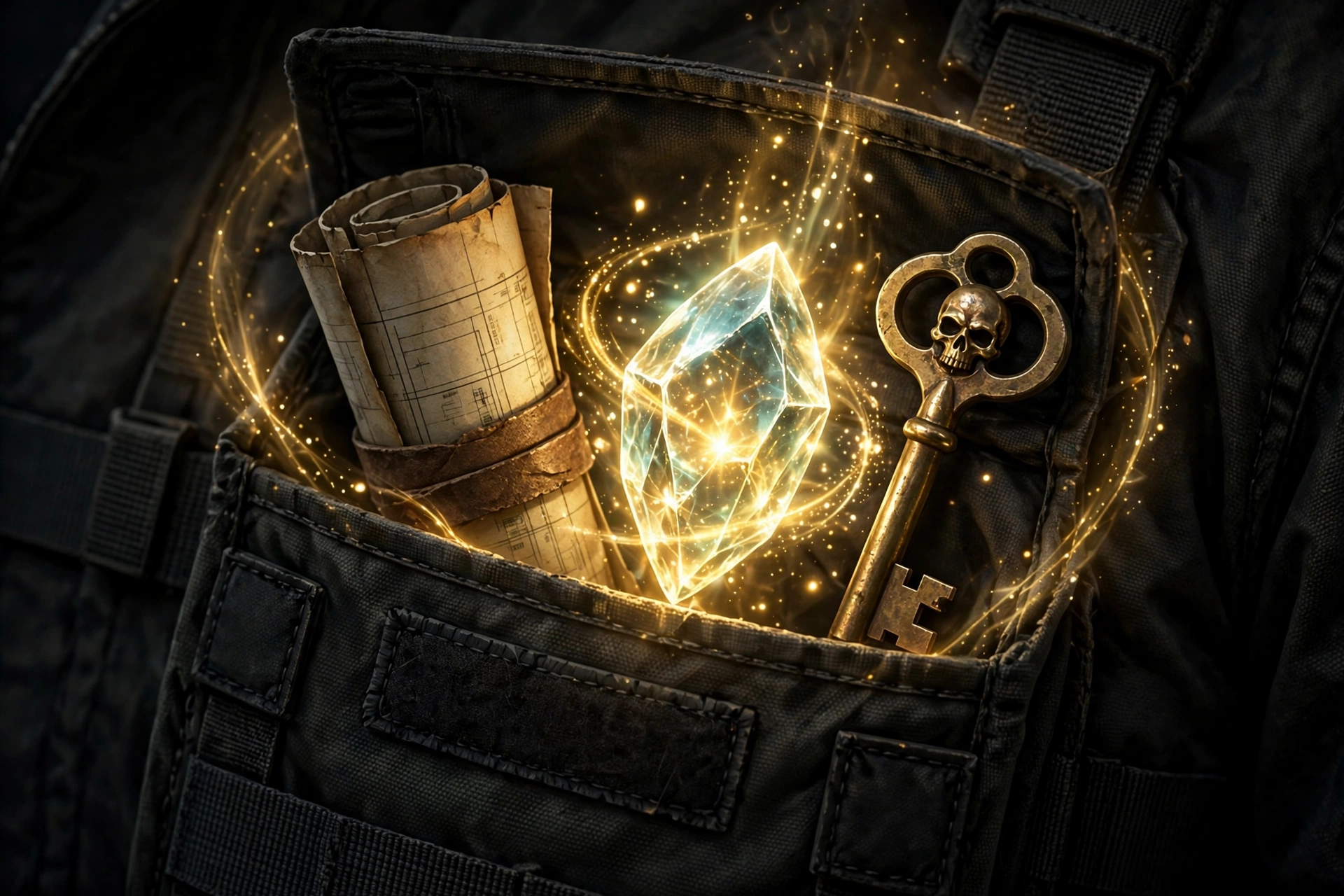
Your Safe Pocket is small, so it needs a strict order. Only bump a lower item out for a higher one.
First, blueprints. They are the top priority because they permanently unlock recipes. Lose one and the recipe stays locked until you find another.
Second, quest items. These are usually single drops tied to a specific task. Losing one means repeating the whole trip, so pocket it the moment you pick it up.
Third, rare crafting parts. These are the ARC components and boss cells you cannot buy or craft. A boss cell that took a whole raid to find is exactly what the Safe Pocket exists for.
Fourth, Raider Hatch Keys. Keys allow quiet private extraction and are expensive to replace. If a slot is free after the first three, protect a key.
That order holds at every stage, but your slot count changes. You start with one slot on a non-free augment. Looting MK.2 adds a second, Epic Looting MK.2 gives three. GamesRecon reports Looting MK.2 is sold by Trader Lance at the Clinic in Speranza, needs Level 7 and costs 6,000 Raider Coins, but only that one source states all three details, so treat it as reported until you check it in game. The free loadout has no Safe Pocket, so moving to a basic augment is the cheapest survival upgrade you can make.
Stash space tricks that actually work
Bullet summary
- Attach loose mods to weapons instead of storing them loose.
- Store some materials as loot items that recycle into more per slot.
- Cap low-tier consumables instead of hoarding them.
- Use the sort and compact button before you drop anything.
A full stash usually comes from storing things the wrong way. These four tricks cost nothing.
Attach loose mods to weapons instead of storing them loose. A loose mod takes a slot and does nothing. Attached to a weapon it takes no stash slot and raises the resale value. Attach every loose mod you own and watch whole rows open up.
Store some materials as loot items that recycle into more per slot. Some loot items recycle into more materials than the same materials take as raw storage. A Broken Handheld Radio, for example, recycles into sensors. Keep the compact item and break it down at the workbench when you need the materials.
Cap low-tier consumables instead of hoarding them. Low-tier meds, ammo and throwables are cheap to replace, so there is no reason to keep fifty of each. Cap them at two or three raids worth, sell or recycle the rest, and stop picking them up once you hit the cap.
Use the in-game sort and compact button before deciding to drop anything. Stashes look fuller than they are when items are scattered. Sort and compact first, then look at what is actually taking space. Many players drop good items they never needed to drop.
TopGameCarry lists the stash at 64 to 280 slots, but only that one source states this range, so do not treat it as a fixed number. Whatever your cap is, the tricks above are how you live inside it.

What changed in recent updates
Bullet summary
- Live Update 2.3.0 on 27 Oct 2026 moved higher-tier loot deeper into the map.
- Lower-tier rewards now sit closer to the Emperor’s entrance.
- Older guides written before that patch may list loot locations that no longer hold.
- The Frozen Trail update on 8 Oct 2026 is the largest update since the 2025 launch.
Loot advice goes stale fast, so check the date on any guide you follow. GameBrief notes Live Update 2.3.0, released on 27 October 2026, moved higher-tier loot deeper into the map, with lower-tier rewards now near the Emperor’s entrance. A pre-patch guide may point you at loot that is no longer there.
The TopGameCarry loot guide is marked current as of June 2026 Patch 1.34.0, months older than Live Update 2.3.0. Its keep and sell lists are still useful, but its loot locations and yield claims should not be copied without checking them against the current patch.
The Frozen Trail update on 8 October 2026 is the largest update since the 2025 launch, according to Nexon, and it brought lapsed players back in large numbers. If you are returning after a break, re-learn the routes before you plan a farming run around them.
Frequently asked questions
What happens to my loot if I die in ARC Raiders?
You lose everything except what is in your Safe Pocket. It auto-extracts its contents even if you die, so put blueprints, quest items, rare crafting parts and Raider Hatch Keys there first.
How many Safe Pocket slots can I get?
You start with one slot when you use a non-free augment. Looting MK.2 adds a second slot, and Epic Looting MK.2 gives you three slots. The free loadout has no Safe Pocket at all.
Should I sell or recycle trinkets in ARC Raiders?
Sell them. Trinkets such as statuettes, music albums, spectrometers and rare reactors are designed to be sold for Coins, and their coin value beats their material value.
Where do I recycle items for full yield?
Recycle at your hideout workbench in Speranza for full yield. Salvaging inside a raid returns roughly half the materials, so only salvage in a raid when you need the space right now.
What should I put in my Safe Pocket first?
Blueprints first, because they permanently unlock recipes. Then quest items, then rare crafting parts, then Raider Hatch Keys. Only bump a lower item out when a higher-priority item appears.
How long does a raid last, and what happens when the timer runs out?
Each raid lasts 30 minutes. When the timer hits zero, an orbital strike wipes the map, so head for extraction before the clock runs down.

Related guides
- ARC Raiders Best Settings and Beginner Tips: https://savygames.com/arc-raiders-best-settings-and-beginner-tips-2026-guide/
- ARC Raiders PvE Mode: Easy to Add, Not Confirmed: https://savygames.com/arc-raiders-pve-mode-not-confirmed/
- ARC Raiders Holds Steam No. 1 Spot for a Ninth Straight Week: https://savygames.com/arc-raiders-holds-steams-no-1-spot-for-a-ninth-straight-week-as-embark-teases-tougher-pve-and-a-walkable-speranza-hub/
- ARC Raiders Passes 17 Million Sales, Nexon Says: https://savygames.com/arc-raiders-passes-17-million-sales-nexon-says/